
Blog
Three-hole blades: Precision cutting and material performance analysis in various industries

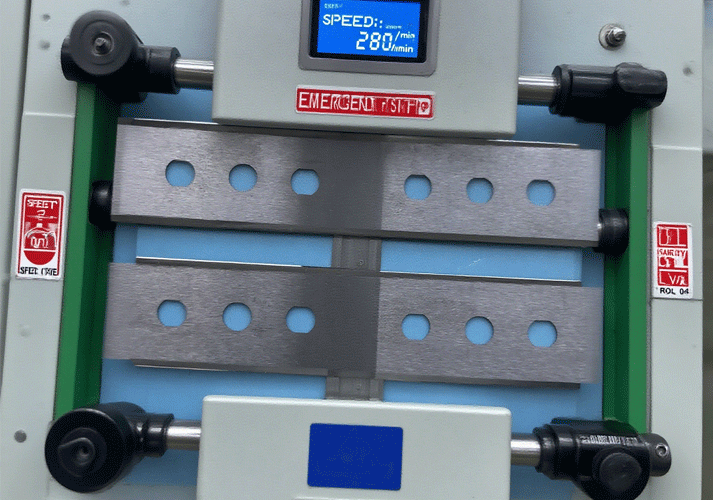
In modern industrial manufacturing, precise cutting is a crucial step in many production processes. The three-hole blade, as a specially designed industrial cutting tool, with its unique structure and excellent performance, has become a core component in the field of precise cutting. This article will delve into the industry applications and performance characteristics of different materials of the three-hole blade from two aspects: industry application and material performance.
I. Overview and structural features of the three-hole blade
The three-hole blade is a precision cutting tool with three installation holes on the blade. These holes are mainly used for precise positioning, secure installation, and heat dissipation. This design enables it to adapt to high-speed operation and precise control requirements, ensuring the stability and accuracy of the cutting process. The standard diameter range of the three-hole blade is typically between 43mm and 60mm, and the thickness is between 0.2mm and 0.5mm. The most common specifications include 43 * 22 * 0.2, 43 * 22 * 0.3, 43 * 22 * 0.4, and 60 * 22 * 0.3.
II. Industry application areas of the three-hole blade
The three-hole blade, due to its high precision and durability, is widely used in the following industries:
1. Packaging industry
The three-hole blade is widely used in the packaging industry for cutting various film materials. These include:
• BOPP/CPP film cutting
• Aluminum foil composite material cutting strips
• Soft packaging bag making
• Transparent tape cutting, especially transparent tape cutting
• Pearl film, heat insulation film, etc., special films cutting
These applications require the blade to have extremely high sharpness and wear resistance to ensure smooth and non-irregular cutting edges without affecting the material’s own properties.
2. Printing industry
In the printing industry, the three-hole blade is mainly used for:
• Roll paper cutting
• Non-woven material cutting strips
• Label die-cutting
• Printing product cutting
These applications have extremely high precision requirements for the blade, and any minor deviation can affect the quality of the final product.
3. Non-woven fabric and textile industry
The three-hole blade plays an important role in non-woven fabric and textile processing:
• Medical non-woven fabric cutting
• Hygiene material cutting strips
• Filter material cutting
• Fabric, yarn cutting and finishing
These applications require the blade to have good corrosion resistance and ensure smooth cutting edges without fiber shedding, guaranteeing the hygiene and safety standards of the products.
4. Electronic materials industry
With the development of the electronics industry, the application of the three-hole blade in this field is increasing:
• Lithium battery separator cutting
• Optical film material cutting
• Conductive film processing
• Copper foil, aluminum foil, etc., metal material cutting
These applications often require a clean and precise environment, with extremely high requirements for the cleanliness and precision of the blade.
5. Other industrial fields
In addition, the three-hole blade is also widely used in:
• Metal processing industry: stainless steel, carbon steel, alloy steel, etc., metal cutting
• Mold manufacturing: high-precision, high-wear-resistant mold processing
• Plastic and rubber industry: cutting, cutting, punching, etc. processes
• Paper industry: paper cutting and punching
• Wood and furniture industry: high-precision wood cutting
• Aerospace and automotive manufacturing: precise processing of special materials
III. Performance characteristics of the three-hole blade in different materials
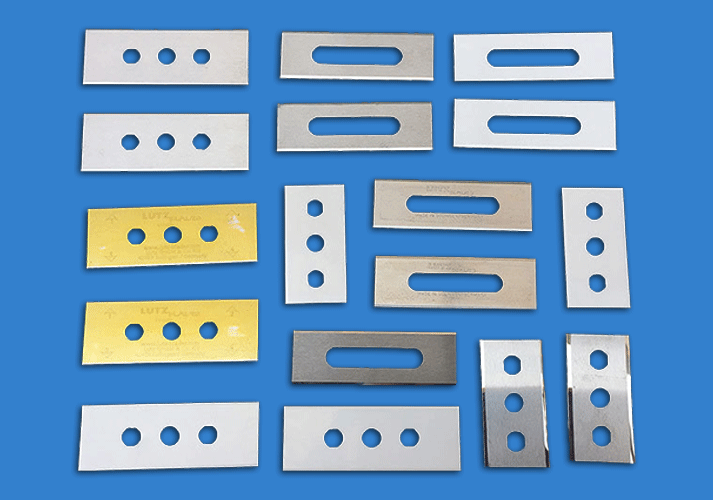
The performance of the three-hole blade is largely dependent on its material. Currently, the three-hole blades on the market mainly have three materials: carbon steel, tungsten steel (hard alloy), and ceramics. Each material has its unique performance characteristics and application scenarios.
1. Carbon steel three-hole blade
Carbon steel is a traditional blade material and is also used in three-hole blades. The most common is carbon tool steel SK5 material.
Performance characteristics: • General hardness: Compared to tungsten steel and ceramics, the hardness of carbon steel is lower.
• Poor wear resistance: The service life is shorter.
• Low cost: The price is economical.
• Easy to process: It is easy to shape and sharpen.
Common specifications: 60 * 22 * 0.2, 43 * 22 * 0.2, 43 * 22 * 0.3, 43 * 22 * 0.4, 43 * 22 * 0.5
Applicable scenarios: Suitable for some non-demanding cutting situations, such as the cutting of ordinary paper, low-strength films, etc., as well as cost-sensitive application scenarios.
2. Tungsten steel three-hole blade (hard alloy)
The tungsten steel three-hole blade is currently the most widely used high-performance three-hole blade, made of nano ultra-fine particle tungsten-cobalt material.
Performance characteristics:
• Extremely high hardness: Hardness up to HRA 90-93, much higher than carbon steel
• Excellent wear resistance: Wear resistance is 5-8 times that of ordinary alloy blades, and the service life is 2-3 times that of ordinary tungsten steel materials, over 100 times that of high-carbon steel blades.
• High heat resistance: Continuous working temperature stability reaches 600℃
• Sharp cutting edge: Adopting a three-layer fine grinding process, the roughness of the cutting edge is controlled within Ra 0.08-0.14 μm
• Double-sided blade design: Can be flipped for use, improving the utilization rate of the blade
• Manufacturing process: Selecting nano ultra-fine particle tungsten-cobalt material, removing sand holes through heat equal pressure treatment, high-temperature sintering, and refinement. The manufacturing process includes: material selection → shaping processing → heat treatment → precision processing → grinding → precision inspection → piece inspection → qualified for shipment.
Common specifications: 43 * 22 * 0.2, 43 * 22 * 0.3, 43 * 22 * 0.4
Applicable scenarios: Suitable for most high-precision, high-strength cutting situations, especially for the cutting of various films, tapes, foil materials, non-woven fabrics, etc.
3. Ceramic three-hole blade
The ceramic three-hole blade is a high-performance cutting tool developed in recent years, mainly characterized by its extremely high hardness and wear resistance.
Performance characteristics:
• Extremely high hardness: Hardness exceeds tungsten steel, suitable for cutting hard materials
• Excellent wear resistance: Performs well in cutting high-hardness materials
• Strong corrosion resistance: Has good chemical stability
• Low thermal expansion coefficient: Good thermal stability
• High brittleness: Prone to cracking and wear, requires more caution when using
Usage precautions: When using ceramic three-hole blades, special attention should be paid to the protection and maintenance of the blade. Avoid collisions and excessive wear. Before use, check if the blade appearance has any defects or damages. Avoid dragging or scratching on hard surfaces. Carefully control the usage force and speed.
Applicable scenarios: Often used for high-precision cutting of hard materials, such as metals, glass, ceramics, etc.
Ⅳ. Three-Hole Blade Selection and Usage Suggestions
1. Selection suggestions
When choosing three-hole blades, consider the following factors:
• Processing materials: Different materials require different material blades
• Precision requirements: High-precision occasions require high-precision blades
• Production efficiency: High-speed production requires more wear-resistant blades
• Cost budget: Find a balance between performance and cost
2. Usage and maintenance
Correct usage and maintenance can extend the service life of the three-hole blades:
• Correct installation: Install using a torque wrench to ensure uniform force
• Gap adjustment: The recommended gap for the blade is 10% of the material thickness
• New blade grinding: New blades are recommended for low-speed grinding for 30 minutes
• Regular cleaning: Clean the blade surface of residual substances at the end of each shift
• Regular inspection: Regularly inspect the condition of the cutting edge
• Proper storage: Protect with anti-rust oil when storing

3. Wear and tear judgment
Timely assessment of blade wear conditions is crucial for ensuring product quality:
• Presence of burrs at the cut edges
• increase in the resistance during splitting
• Stretch deformation at the material edges
V. Conclusion
The three-hole blade, as the core tool in the field of precise cutting, is applied in multiple industries such as packaging, printing, non-woven fabric, and electronic materials. Different materials have their own performance characteristics for the three-hole blades: carbon steel blades are economical and practical, tungsten steel blades have excellent comprehensive performance, and ceramic blades perform well in specific fields. With the continuous development of manufacturing, the materials and manufacturing processes of the three-hole blades will continue to innovate, providing more efficient and precise cutting solutions for various industries. Correct selection and use of the three-hole blades can not only improve product quality and production efficiency, but also reduce production costs and create greater value for enterprises.